
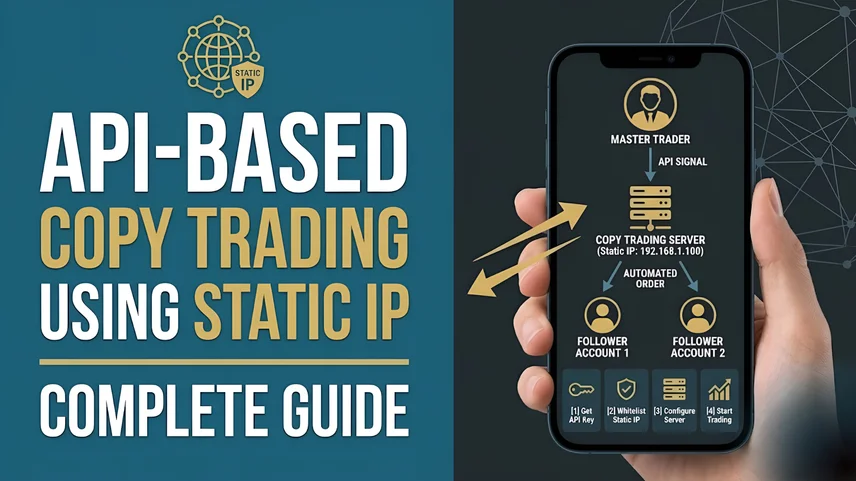
Copy trading has become a popular way for traders to automate trade execution across multiple accounts. Instead of manually placing the same order in every account, copy trading software can automatically replicate trades from a master account to one or more child accounts.
To ensure secure and reliable trade execution, many traders use broker APIs along with a Static IP setup. This combination is extremely useful in maintaining a consistent and high level of performance in the automated trading platform.
In this guide, we will explain about API based copy trading and how a Static IP is used for a stable trading setup.
A Static IP provides a fixed network address that remains unchanged. Many traders prefer using a Static IP because it offers several advantages when working with broker APIs.
A stable connection is especially important when managing multiple trading accounts through automated systems.
API-based copy trading connects trading accounts through secure broker APIs.
The process usually follows these steps:
This helps traders manage multiple accounts efficiently while reducing manual work.
Step 1: Obtain Broker API Access
Before setting up copy trading, you need API access from your broker.
Depending on the broker, the process may include:
Always review your broker's API terms and requirements before enabling automated trading.
Step 2: Configure a Static IP
After obtaining API access, configure a dedicated Static IP for your trading setup.
A Static IP helps maintain a consistent connection between:
Many trading environments use IPv4-based Static IP addresses because they are widely supported.
Step 3: Connect Your Trading Account
Once your API credentials are ready:
The software will then establish communication with your broker account.
Step 4: Configure Security Authentication
Most modern brokers require additional security verification.
Common authentication methods include:
These security measures help protect trading accounts and API access.
Step 5: Set Up Master and Child Accounts
A copy trading system generally consists of:
Master Account
The account that generates and executes the original trades.
Child Accounts
The accounts that automatically receive copied trades based on predefined settings.
You can customize:
This flexibility allows traders to manage different account sizes effectively.
A properly configured copy trading system can provide:
These advantages make copy trading popular among active traders and portfolio managers.
To improve system performance:
Using a Static IP with API-based copy trading will be a robust solution to automate trades across multiple accounts. By correctly setting up all the necessary configurations, traders can ensure better consistency of execution, reduce the manual efforts and better handle different portfolios.
Before starting off any automated trading solution, ensure to check if your broker provides API access and ensure all the security and risk management is done properly.
Frequently Asked Questions
1. Is a Static IP required for copy trading?
Not always. However, some broker APIs require IP whitelisting, and a Static IP can improve connection stability and security.
2. Can I copy trades across multiple accounts?
Yes. Most modern copy trading platforms allow trades to be replicated from a master account to multiple child accounts.
3. What is API-based copy trading?
API-based copy trading uses broker APIs to automatically replicate trades between connected accounts.
4. Is copy trading secure?
Copy trading can be secure when combined with strong authentication, encrypted API connections, and proper risk management.
5. Why do traders use Static IPs?
Static IPs help maintain stable API connectivity, improve security, and reduce interruptions during automated trading operations.